Query fan-out examples
This page shows what a query fan-out looks like. Every example carries one of three labels, and the labels are never mixed in one table. OBSERVED means the platform displayed the subqueries and we captured them as displayed. RECONSTRUCTED means the subqueries were not shown and have been inferred from what was retrieved or cited. SYNTHETIC means the decomposition was written as an illustration and was never produced by any search system.
Google's own illustration
DOCUMENTED The only worked example we located in Google's public documentation as of September 2026. It is an illustration written by Google ("might include"), not a capture.
- best herbicides for lawns
- remove weeds without chemicals
- how to prevent weeds in lawn
Observed fan-outs
OBSERVED All from Perplexity, signed-in free account in Colorado, 8 September 2026 UTC (the evening of 7 September local time), captured from the platform's own "steps" panel. Full records with source counts and cited domains are in the dataset.[2]
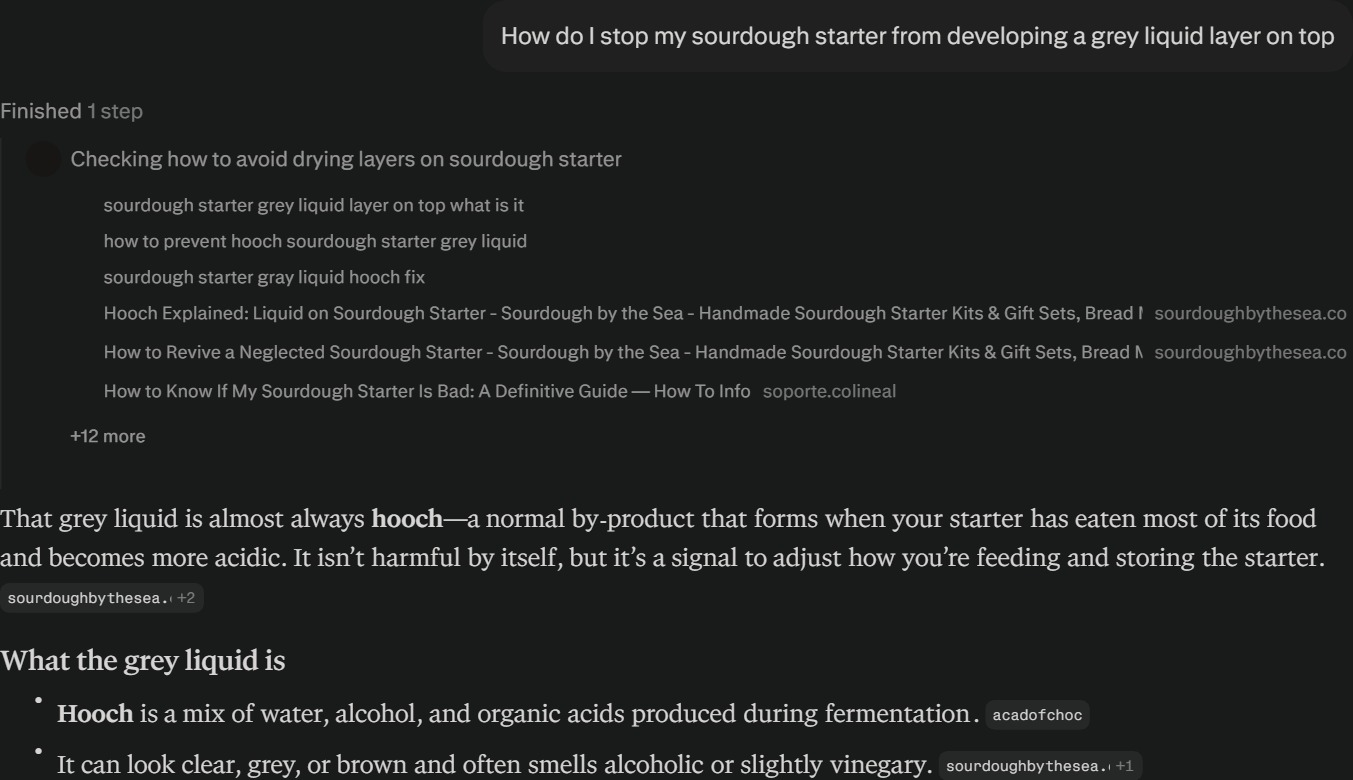
Long-tail informational (qfo-0003)
- sourdough starter grey liquid layer on top what is it
- how to prevent hooch sourdough starter grey liquid
- sourdough starter gray liquid hooch fix
Comparison (qfo-0004)
- Sony WH-1000XM6 vs Bose QuietComfort Ultra long flights
- Sony WH-1000XM6 battery life ANC comfort review 2025 2026
- Bose QuietComfort Ultra battery life ANC comfort long flight review
Commercial recommendation (qfo-0005)
- best standing desk under $400 2025 2026
- compact standing desk small apartment under $400
- standing desk reviews small space budget
Rare topic (qfo-0007)
- Tsagaan Sar traditional dairy dishes Uvs province Mongolia
- Mongolian Tsagaan Sar food dairy products Uvs
- traditional Mongolian dairy dishes holiday Tsagaan Sar
Freshness-sensitive (qfo-0008)
- iOS 26.0 update changes features
- Apple iOS latest update September 2026 what's new
- iOS 26 release notes changes
Local (qfo-0009)
- best time to visit Great Sand Dunes National Park avoid crowds
- Great Sand Dunes National Park least crowded months weekdays
- Great Sand Dunes National Park crowd patterns seasonal tips
Product (qfo-0010)
- DJI Mini 5 Pro vs Mini 4 Pro differences specs
- DJI Mini 5 Pro worth it over Mini 4 Pro review
- DJI Mini 5 Pro release date price features
The same prompt three times
OBSERVED One prompt, three fresh threads, twelve minutes apart, 8 September 2026 UTC. This is the repeat-run test described in the methodology.
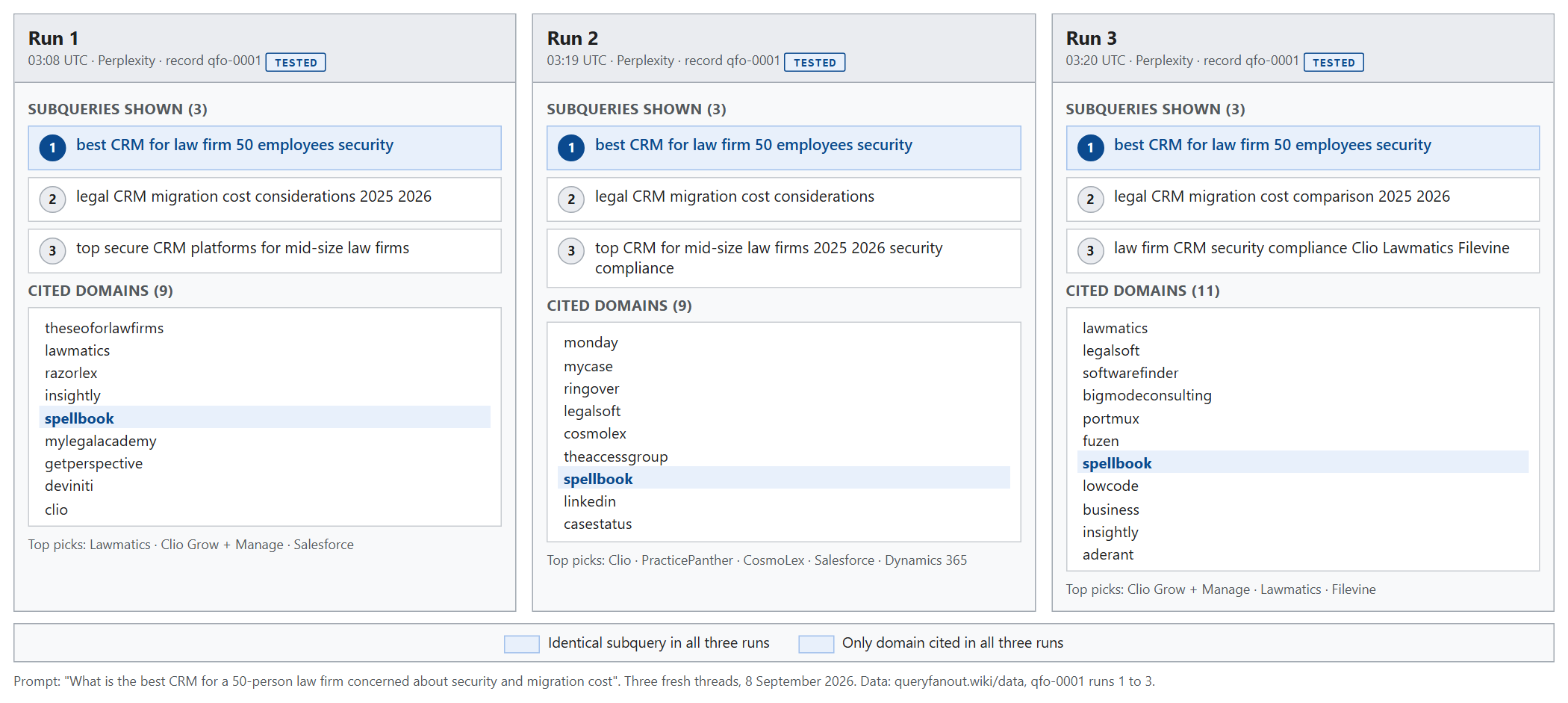
| Run 1 (03:08 UTC) | Run 2 (03:19 UTC) | Run 3 (03:20 UTC) | |
|---|---|---|---|
| Prompt | What is the best CRM for a 50-person law firm concerned about security and migration cost | ||
| Step label | Researching secure and cost-effective CRM options | Searching for secure CRM options for a small law firm | Comparing cybersecurity considerations |
| Subquery 1 | best CRM for law firm 50 employees security | best CRM for law firm 50 employees security | best CRM for law firm 50 employees security |
| Subquery 2 | legal CRM migration cost considerations 2025 2026 | legal CRM migration cost considerations | legal CRM migration cost comparison 2025 2026 |
| Subquery 3 | top secure CRM platforms for mid-size law firms | top CRM for mid-size law firms 2025 2026 security compliance | law firm CRM security compliance Clio Lawmatics Filevine |
| Sources retrieved | 15 | 15 | 15 |
| Domains cited | 9 | 9 | 11 |
| Top recommendations | Lawmatics; Clio Grow + Manage; Salesforce | Clio; PracticePanther; CosmoLex; Salesforce; Dynamics 365 | Clio Grow + Manage; Lawmatics; Filevine |
What stayed the same: the first subquery, word for word, all three times. The second subquery kept its meaning and varied its tokens. What changed: the third subquery each time, and almost the entire set of cited domains. Only one domain (spellbook) was cited in all three runs. The recommended products differed in every run. Three runs is a tiny sample, and it is enough to show that stable subqueries do not produce stable answers.
Prompts that did not fan out
OBSERVED Two of the eleven launch prompts produced a single search identical to the prompt. On this platform, at least, fan-out is conditional.
- How tall is the Eiffel Tower
- jaguar speed
A follow-up turn
OBSERVED A second turn in the headphones thread: "Which one has better battery life". The platform showed no step panel at all for this turn, yet attached 9 sources, two of them from domains not present in the first turn. Retrieval happened; the subqueries were not disclosed. Record qfo-0011 is therefore fanout_observable: false, and it is the reason the dataset has that field.
A reconstructed fan-out
RECONSTRUCTED When a platform does not show its subqueries, the only way to say anything about them is to work backwards from what it cited. Here is what that looks like for the follow-up turn above, and it is inference, not observation.
| Cited domain | Content it supplied | Information need it answers |
|---|---|---|
| headphonecurve | Rated battery figures for both models | manufacturer battery ratings |
| soundguys, mute-zone | Independent test results for the Sony | Sony WH-1000XM6 tested battery life |
| techtimes | Real-world figures for the Bose with spatial audio on | Bose QC Ultra battery life with Immersive Audio |
A reconstruction can tell you what information needs the response covered. It cannot tell you how many searches ran, what they were worded, or whether the platform ran searches whose results it discarded. That is why a reconstructed row never gets a subquery_count.
Synthetic decompositions
SYNTHETIC Written by hand or generated by a simulation tool. Useful for planning content. Never evidence of what any system did.
- CRM for law firms
- CRM security compliance
- CRM pricing for 50 users
- CRM migration costs
- Salesforce vs HubSpot for legal firms
- legal CRM integrations
- CRM onboarding time
Simulation tools such as Qforia, queryfanout.io and the LLMrefs generator produce lists of this kind, typically ten to thirty items, by asking a language model what a search system might search for.[3] They are labelled SYNTHETIC here regardless of how they describe themselves. The Measurement page lists which tools observe and which simulate.
Patterns worth noting
TESTED From eleven prompts and two repeats on one platform. Small sample; patterns, not laws.
- Three is the default. Every prompt that fanned out produced exactly three subqueries. Neither more complex prompts (the CRM prompt) nor rarer ones (Uvs) changed the count.
- The first subquery is a paraphrase. In nine of nine fan-outs, subquery 1 restated the prompt in search-engine phrasing. It was also the stable one across repeat runs.
- Year tokens are added. "2025 2026" appeared in five of the nine fan-outs, never in the prompt.
- Comparisons split by entity. One query per product, each with the same attribute list.
- The system names things before it searches. "Hooch" for the sourdough prompt; "Clio Lawmatics Filevine" in the third CRM run. The decomposition model brings its own knowledge into the subqueries.
- Fan-out size did not predict source count. Single-search prompts retrieved 9 sources; three-subquery prompts retrieved 15 to 23.
- Follow-ups hide their searches. The second turn attached sources without showing any step.
References
- Google Search Central. "Optimizing your website for generative AI features on Google Search." 15 May 2026, updated 10 July 2026. developers.google.com.
- QueryFanout.wiki. "Query Fan-Out Observatory, batch 1." 8 September 2026. Dataset version 0.1.0. queryfanout.wiki/data/. Each record links to the Perplexity thread it was captured from.
- Anconitano, Veruska. "Query fan-out tools and software." Search Engine Land, 22 April 2026. searchengineland.com.
- Information retrieval
- AI search
- Google AI Mode