What Google has said about query fan-out
This page contains only what Google has said in public about query fan-out, quoted verbatim with author, date and URL, in chronological order. Nothing here is paraphrased. Where a frequently cited Google page does not contain the phrase, that is recorded too, because the mis-citations are as common as the citations. Every entry on this page is DOCUMENTED unless marked otherwise.
What Google has and has not confirmed
| Confirmed by Google | Not confirmed by Google |
|---|---|
| The name "query fan-out", used consistently since at least 5 March 2025, the earliest use we located | Any fixed or typical number of subqueries for AI Mode or AI Overviews |
| The mechanism: break a question into subtopics, issue multiple related searches concurrently across the web and Google's own data sources, combine into one response | How subqueries are generated, selected or ranked |
| Products: AI Mode, Deep Search, Search Live, Web Guide, agentic ticket and shopping flows, and visual variants in Lens, Circle to Search and image search | Whether every AI Mode request fans out; whether any given AI Overview does |
| AI Overviews "may use" it (Search Central documentation) | That any patent describes the production system |
| A gate exists: Search "recognizes when a question needs advanced reasoning" (keynote) | What that gate is |
| Gaps after synthesis can trigger "even more searches" (keynote) | Which Gemini version does the decomposition, beyond "a custom version of Gemini" |
| A formal definition and one worked example (May 2026), the only ones we located as of September 2026 | Any per-site inclusion signal |
Statements, in order
5 March 2025. Earliest located public use
"You can not only access high-quality web content, but also tap into fresh, real-time sources like the Knowledge Graph, info about the real world, and shopping data for billions of products. It uses a "query fan-out" technique, issuing multiple related searches concurrently across subtopics and multiple data sources and then brings those results together to provide an easy-to-understand response. This approach helps you access more breadth and depth of information than a traditional search on Google."Robby Stein, VP of Product, Google Search. "Expanding AI Overviews and introducing AI Mode."[1]
The same post describes the model's behaviour as multi-step: "the custom version of Gemini 2.0 uses a multistep approach to make a plan, conduct searches to find information and adjust the plan based on what it finds." This is the only Google statement that names a Gemini version in connection with AI Mode, and it is the version at launch, not necessarily the version today.
Undated. Google Search Help
"AI Mode expands what AI Overviews can do with more advanced reasoning and ways of interacting. It divides your question into subtopics and searches for each one simultaneously. This way, AI Mode can explore the web to find even more relevant content that matches your question."Google Search Help, "Get AI-powered responses with AI Mode in Google Search", introduction[2]
"AI mode uses a "query fan-out" technique, dividing your question into subtopics and searching for each one simultaneously across multiple data sources. It then brings those results together to provide an easy-to-understand response."Same page, section "How AI Mode works"[2]
7 April 2025. Multimodal AI Mode
"Drawing on our deep visual search expertise, Lens precisely identifies each object in the image. Using our query fan-out technique, AI Mode then issues multiple queries about the image as a whole and the objects within the image, accessing more breadth and depth of information than a traditional search on Google."Robby Stein. "Bringing multimodal search to AI Mode."[3]
20 May 2025. Google I/O, the blog post
"Under the hood, AI Mode uses our query fan-out technique, breaking down your question into subtopics and issuing a multitude of queries simultaneously on your behalf. This enables Search to dive deeper into the web than a traditional search on Google, helping you discover even more of what the web has to offer and find incredible, hyper-relevant content that matches your question."Elizabeth Reid, VP and Head of Search. "AI in Search: Going beyond information to intelligence."[4]
"Deep Search uses the same query fan-out technique but taken to the next level. It can issue hundreds of searches, reason across disparate pieces of information, and create an expert-level fully-cited report in just minutes, saving you hours of research."Same post[4]
"Just ask, "Find 2 affordable tickets for this Saturday's Reds game in the lower level" and AI Mode will kick off a query fan-out, looking across sites to analyze hundreds of potential ticket options with real-time pricing and inventory, and handle the tedious work of filling in forms."Same post, on agentic capabilities[4]
20 May 2025. Google I/O, on stage
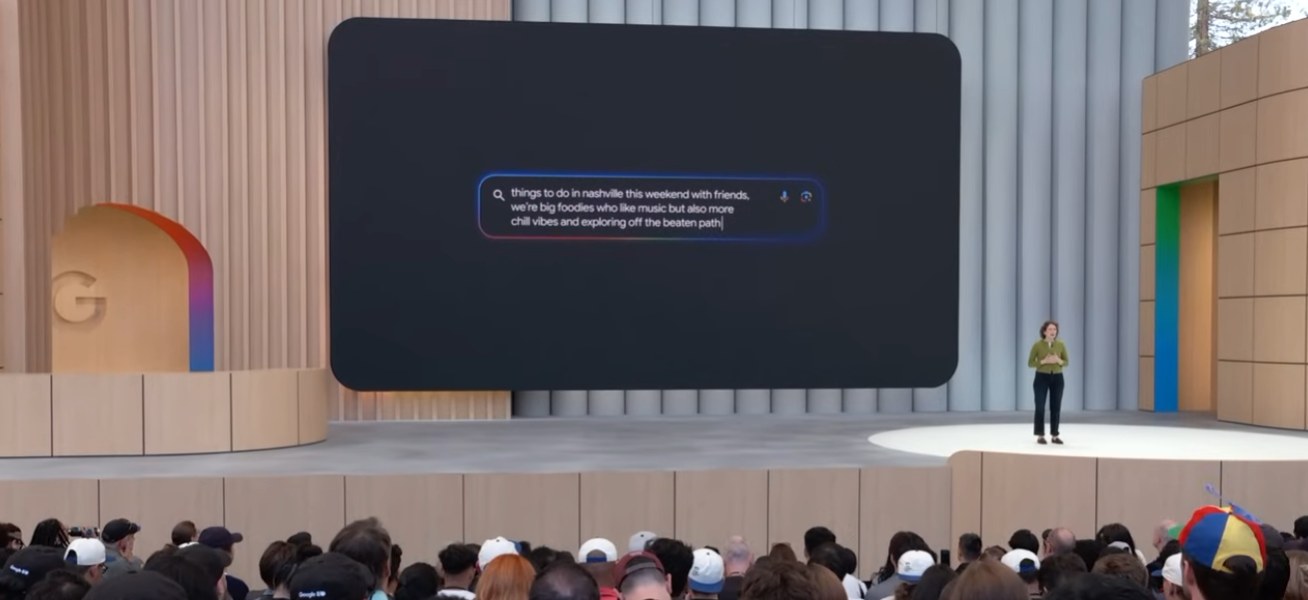
The keynote is the most detailed description Google has given, and the only one that mentions a gate and a feedback loop. From Google's own captions:
"What makes this possible is something we call our query fanout technique. Now, under the hood, Search recognizes when a question needs advanced reasoning. It calls on our custom version of Gemini to break the question into different subtopics. And it issues a multitude of queries simultaneously on your behalf. It searches across the entire web, going way deeper than a traditional search. And it taps into all of our datasets of real-time information, like the knowledge graph, the shopping graph, and, in this case, local data, including insights from our Maps community of over 500 million contributors. Search pulls together a response. And it checks its work to make sure it meets our high bar for information quality. And if it detects any gaps, it issues even more searches to fill them in. That means with AI Mode, you get all of this from just a single search."Elizabeth Reid, Google I/O 2025 keynote, Search segment[5]
"Deep Search uses the same query fanout technique you just heard about but multiplied. It can issue dozens or even hundreds of searches on your behalf."Elizabeth Reid, same keynote[5]
20 May 2025. Shopping in AI Mode
"If you want to narrow your options down to bags suitable for a trip to Portland, Oregon in May, AI Mode will start a query fan-out, which means it runs several simultaneous searches to figure out what makes a bag good for rainy weather and long journeys, and then use those criteria to suggest waterproof options with easy access to pockets."Lilian Rincon, VP of Product Management. "Shop with AI Mode, use AI to buy and try clothes on yourself virtually."[6]
5 June 2025. Monthly AI round-up
"For questions where you want an even more thorough response, this summer we're bringing Deep Search to AI Mode, which takes AI Mode's same query fan-out technique to the next level.""The latest AI news we announced in May."[7]
18 June 2025. Search Live
"Search Live with voice also uses our query fan-out technique to show you a wider and more diverse set of helpful web content, enabling new opportunities for exploration."Liza Ma, Director of Product Management, Search. "Search Live: Talk, listen and explore in real time with AI Mode."[8]
24 June, 28 July and 8 October 2025. Regional launches
The India, United Kingdom and Australia launch posts, all by Hema Budaraju, repeat the I/O wording almost exactly. The Australian post drops the word "simultaneously":
"Behind the scenes, AI Mode uses a query fan-out technique, breaking your question into subtopics and issuing a multitude of queries on your behalf."Hema Budaraju, VP of Product Management, Search. "Google Search: Introducing AI Mode in Australia."[9]
24 July 2025. Web Guide
"Similar to AI Mode, Web Guide uses a query fan-out technique, concurrently issuing multiple related searches to identify the most relevant results."Austin Wu, Group Product Manager, Search. "Web Guide: An experimental AI-organized search results page."[10]
30 September 2025. Visual search fan-out
"Building on our powerful query fan-out approach, our new "visual search fan-out" technique allows us to have a deeper understanding of precisely what's in an image. This means AI Mode can perform a more comprehensive analysis of an image, recognizing subtle details and secondary objects in addition to the primary subjects – and then runs multiple queries in the background."Robby Stein. "AI Mode can now help you search and explore visually."[11]
18 November 2025. Gemini 3
"Thanks to Gemini 3's advanced reasoning, Google Search's query fan-out technique is getting a major upgrade. Now, not only can it perform even more searches to uncover relevant web content, but because Gemini more intelligently understands your intent it can find new content that it may have previously missed."Elizabeth Reid. "Google Search with Gemini 3: Our most intelligent search yet."[12]
10 December 2025 (last updated). Search Central documentation
"Both AI Overviews and AI Mode may use a "query fan-out" technique — issuing multiple related searches across subtopics and data sources — to develop a response. While responses are being generated, our advanced models identify more supporting web pages, allowing us to display a wider and more diverse set of helpful links associated with the response than with a classic web search, enabling new opportunities for exploration. AI Mode and AI Overviews may use different models and techniques..."Google Search Central, "AI features and your website"[13]
This is the only Google page that attaches fan-out to AI Overviews, and it says "may". It is also the source of the phrase "a wider and more diverse set of helpful links", which is the closest Google has come to stating what fan-out does for publishers.
25 February 2026. Circle to Search
"This next-generation Circle to Search experience is made possible by Gemini 3's agentic planning, reasoning and tool capabilities, which also enhances our visual query fan-out technique. Instead of simply looking for a single match, the model now thinks through a multi-step plan... It automatically identifies the most important parts of an image to crop, runs several searches at once, and cross-references what it finds to compile a final response"Harsh Kharbanda, Director of Product Management, Search. "See the whole picture and find the look with Circle to Search."[14]
5 March 2026. "A dozen searches"
"AI Mode is basically doing a dozen searches for you in the time it takes to do one. ... Before, you'd ask those one by one. Now, AI Mode identifies all those necessary "fan-out" searches."Dounia Berrada, Senior Engineering Director, Search, interviewed by Molly McHugh-Johnson. "Ask a Techspert: How does AI understand my visual searches?"[15]
This is the nearest thing to a per-query number Google has given for ordinary AI Mode. It is an engineer's illustration in an interview about visual search, not a specification.
6 May 2026. Generative AI in Search
"We're continuing to enhance how we show and rank links in our generative AI Search experiences and using techniques like query fan-out, which helps us dive deeper into the web to find the most relevant sites for your search."Hema Budaraju. "5 new ways to explore the web with generative AI in Search."[16]
15 May 2026. The formal definition
See the next section.
19 May 2026. Google I/O 2026
The I/O 2026 blog post does not use the phrase. On stage, Robby Stein used the verb only:
"With Gemini 3.5 Flash Search plans the ideal response from scratch. It designs the layout, decides what custom components to build fans out to do the research, and then finally deploys the code to build custom components like these in the response."Robby Stein, Google I/O 2026 keynote, Search and Shopping segment[17]
14 July 2026. Visual image fan-out
"Using a "visual image fan-out" technique, it breaks a single image search into dozens of sub-queries to understand the full visual context and deliver relevant results."Brad Kellett, Senior Engineering Director, Search. "Celebrating 25 years of visual search innovation."[18]
Google's formal definition
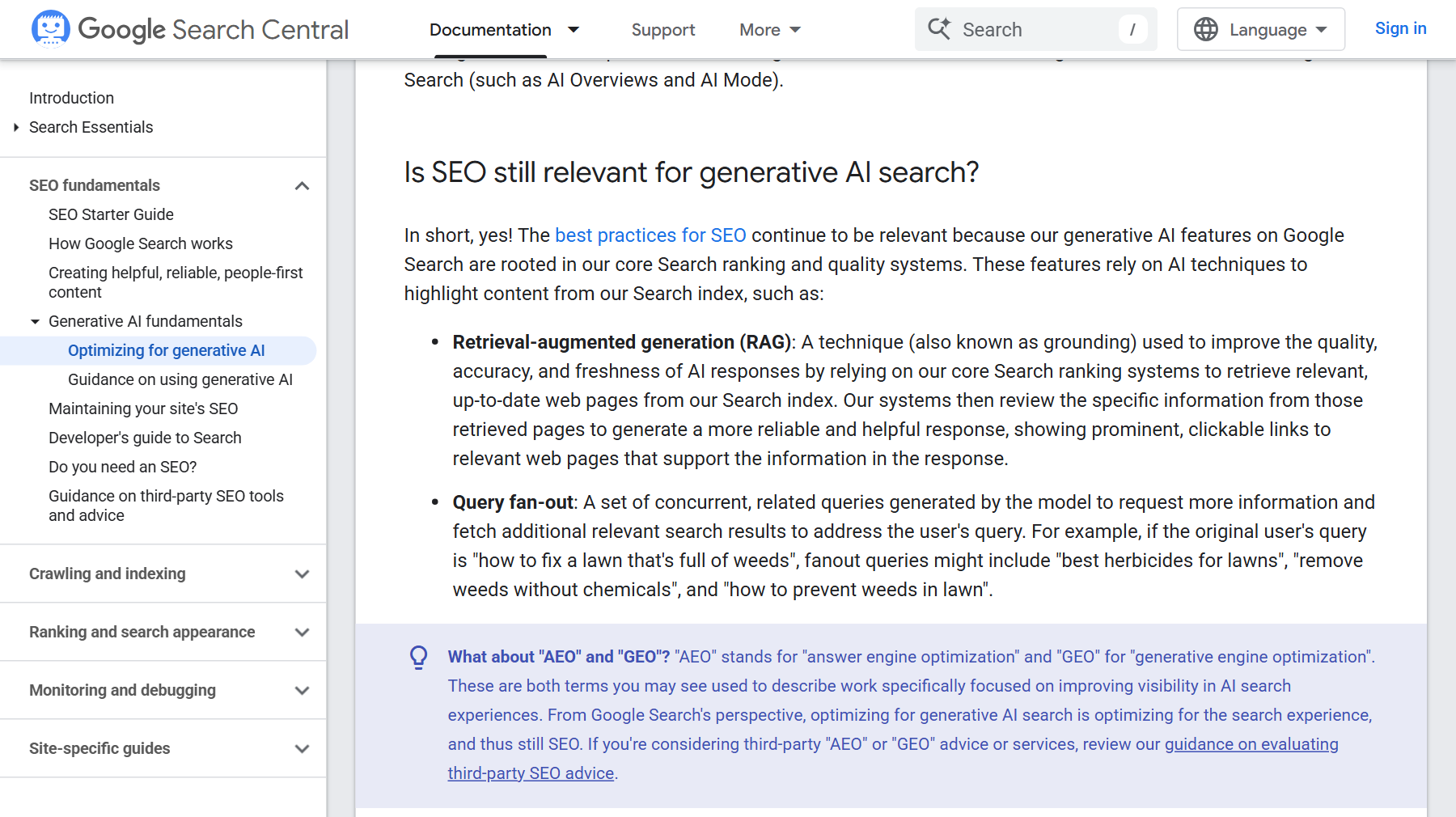
In May 2026 Google published a guide to optimising for generative AI features in Search. Its glossary contains the only formal definition and the only worked example we located in Google's public documentation as of September 2026:
"Query fan-out: A set of concurrent, related queries generated by the model to request more information and fetch additional relevant search results to address the user's query. For example, if the original user's query is "how to fix a lawn that's full of weeds", fanout queries might include "best herbicides for lawns", "remove weeds without chemicals", and "how to prevent weeds in lawn"."Google Search Central, "Optimizing your website for generative AI features on Google Search", published 15 May 2026, last updated 10 July 2026[19]
The same document lists retrieval-augmented generation as a separate glossary entry, "also known as grounding", relying on "our core Search ranking systems to retrieve relevant, up-to-date web pages from our Search index". And it carries a warning that any publisher planning content around fan-out should read in full:
"While it might be tempting to create separate content for every possible variation of how people might search (for example, by focusing on other queries that people have asked, or fan-out queries), doing so primarily to manipulate rankings or generative AI responses in Google Search violates Google's scaled content abuse spam policy."Same document[19]
Has Google ever given a number?
Pages that do not say it
These Google pages are regularly cited as sources for query fan-out. None of them contains the phrase. Cite them for what they do say, not for this.
| Page | What it actually says |
|---|---|
| Search Central Blog, "Top ways to ensure your content performs well in Google's AI experiences on Search", John Mueller, 21 May 2025[20] | Does not use "fan-out" anywhere. Says AI results "may give people more context about a topic overall, and display more relevant supporting links". Links to the "AI features" documentation, where the fan-out language lives. |
| Sundar Pichai, "Google I/O 2025: From research to reality", 20 May 2025 | Does not use the phrase. |
| "A new era of intelligence with Gemini 3", 18 November 2025 | Does not use the phrase. The Search-specific Gemini 3 post does. |
| Gemini app Deep Research pages (gemini.google, Gemini Apps Help, Gemini API docs) | Describe a research plan, sub-tasks run "simultaneously" and browsing "up to hundreds of websites". Never say "fan-out". Deep Research in the Gemini app and Deep Search in AI Mode are different products. |
| AI Overviews help page (support.google.com/websearch/answer/14901683) | Describes generative AI in general terms only. |
| Google I/O 2026 blog post, 19 May 2026 | Does not use the phrase; the keynote used "fans out" once as a verb. |
References
- Stein, Robby. "Expanding AI Overviews and introducing AI Mode." 5 March 2025. blog.google.
- Google Search Help. "Get AI-powered responses with AI Mode in Google Search." support.google.com.
- Stein, Robby. "Bringing multimodal search to AI Mode." 7 April 2025. blog.google.
- Reid, Elizabeth. "AI in Search: Going beyond information to intelligence." 20 May 2025. blog.google.
- Google I/O 2025 keynote, Search segment. youtube.com; full keynote youtube.com.
- Rincon, Lilian. "Shop with AI Mode, use AI to buy and try clothes on yourself virtually." 20 May 2025. blog.google.
- "The latest AI news we announced in May." 5 June 2025. blog.google.
- Ma, Liza. "Search Live: Talk, listen and explore in real time with AI Mode." 18 June 2025. blog.google.
- Budaraju, Hema. "Google Search: Introducing AI Mode in Australia." 8 October 2025. blog.google. India (24 June 2025) and UK (28 July 2025) posts carry the I/O wording.
- Wu, Austin. "Web Guide: An experimental AI-organized search results page." 24 July 2025. blog.google.
- Stein, Robby. "AI Mode can now help you search and explore visually." 30 September 2025. blog.google.
- Reid, Elizabeth. "Google Search with Gemini 3: Our most intelligent search yet." 18 November 2025. blog.google.
- Google Search Central. "AI features and your website." Last updated 10 December 2025. developers.google.com.
- Kharbanda, Harsh. "See the whole picture and find the look with Circle to Search." 25 February 2026. blog.google.
- McHugh-Johnson, Molly; Berrada, Dounia. "Ask a Techspert: How does AI understand my visual searches?" 5 March 2026. blog.google.
- Budaraju, Hema. "5 new ways to explore the web with generative AI in Search." 6 May 2026. blog.google.
- Google I/O 2026 keynote, Search and Shopping segment. youtube.com.
- Kellett, Brad. "Celebrating 25 years of visual search innovation." 14 July 2026. blog.google.
- Google Search Central. "Optimizing your website for generative AI features on Google Search." 15 May 2026, updated 10 July 2026. developers.google.com.
- Mueller, John. "Top ways to ensure your content performs well in Google's AI experiences on Search." Search Central Blog, 21 May 2025. developers.google.com.
- Information retrieval
- AI search
- Google AI Mode