Patents describing query fan-out mechanisms
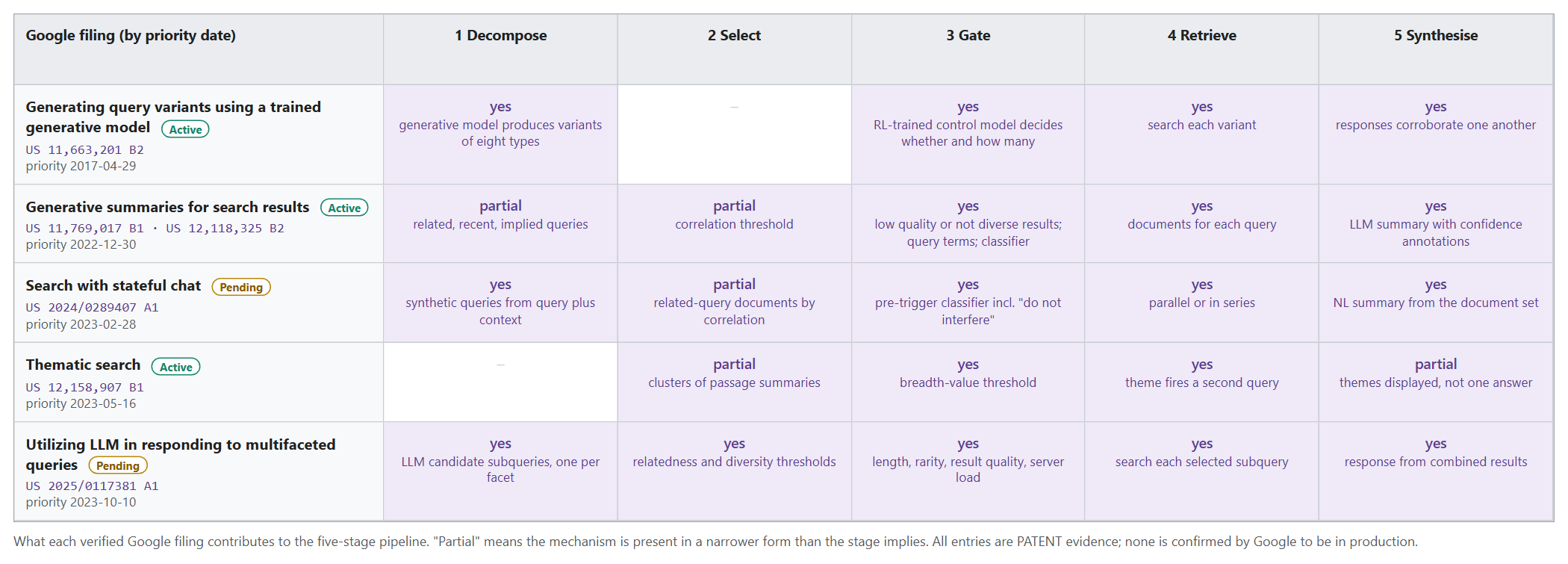
This is a verified register of Google patents and applications that describe mechanisms matching query fan-out: a model generating multiple subqueries from one input, filtering them, searching each, and generating a response from the combined results. Every entry was checked by fetching its page on Google Patents on 7 September 2026 and reading the bibliographic fields, abstract, claims and description directly. Quoted passages are copied without edits.
Register at a glance
| Number | Title | Priority | Status | What it adds |
|---|---|---|---|---|
| US 2025/0117381 A1 | Utilizing large language model (LLM) in responding to multifaceted queries | 2023-10-10 | Pending | The full pipeline: LLM subqueries, relatedness and diversity filtering, per-subquery search, synthesis, and gating |
| US 2024/0289407 A1 | Search with stateful chat | 2023-02-28 | Pending | Synthetic queries from query plus session context; classifier decides which generative path to take, including "do not interfere" |
| US 12,158,907 B1 | Thematic search | 2023-05-16 | Active | Result-side fan-out: passages summarised, clustered into themes, a theme fires a second query; gated on a "breadth value" |
| US 11,663,201 B2 | Generating query variants using a trained generative model | 2017-04-29 | Active | The ancestor: generative query variants; a reinforcement-learned control model decides whether and how many; variant responses corroborate each other |
| US 11,769,017 B1 | Generative summaries for search results | 2022-12-30 | Active | AI Overviews family: documents responsive to related, recent and implied queries feed the LLM summary; gated on result quality and diversity |
| US 12,118,325 B2 | Generative summaries for search results | 2022-12-30 | Active | Same family; independent claim is the decision whether to use an LLM at all, based on query terms and a classifier |
US 2025/0117381 A1. Utilizing large language model (LLM) in responding to multifaceted queries Pending
The closest thing to a literal fan-out patent. Claim 1 recites the whole pipeline. Dependent claims 7 to 12 add the relatedness and diversity metrics; claims 17 to 20 add the gating decision.
| Assignee | Google LLC |
|---|---|
| Inventors | Asaf Revach, Hongrae Lee, Zhengzhong Liang |
| Application | US 18/908,392. Priority 10 October 2023. Filed 7 October 2024. Published 10 April 2025. |
| Family | WO 2025/080561 A1, CN 121986331 A, KR 2026/0048652 A |
| Source | patents.google.com[1] |
Abstract
"Implementations leverage a generative model (e.g., a large language model (LLM)) to generate a plurality of candidate subqueries for multifaceted natural language (NL) based input, where each of the candidate subqueries is potentially directed to a facet or problem of the multifaceted NL based input. Those implementations further select, from the plurality of candidate subqueries and using one or more evaluation metrics, a subset of the candidate queries. Those implementations further, in response to selecting the subset of the candidate queries, obtain, for each of the candidate subqueries of the selected subset, at least one corresponding search result. Those implementations further generate a response to the NL based input based on the corresponding search results for the candidate subqueries of the subset, and cause the response to be rendered responsive to the NL based input."
Claim 1
"A method implemented by one or more processors, the method comprising: receiving natural language (NL) based input associated with a client device; in response to receiving the NL based input: generating a subquery generation prompt that includes the NL based input and additional NL content that promotes subquery generation; generating a plurality of candidate subqueries for the NL based input based on processing the subquery generation prompt using a generative model; selecting, from the plurality of candidate subqueries and using one or more evaluation metrics, a subset of the candidate subqueries generated using the generative model; in response to selecting the subset of the candidate queries: obtaining, for each of the candidate subqueries of the subset, at least one corresponding search result; and generating a response to the NL based input based on the corresponding search results for the candidate subqueries of the subset; and causing the response to be rendered at the client device responsive to the NL based input."
Subquery generation
"In utilizing the LLM in generating the candidate subqueries, many implementations seek to generate a diverse group of subqueries to ensure that the generated subqueries include at least one subquery for each facet of the NL based input."
"Accordingly, through multiple calls of the LLM based on different prompts, a large and diverse group of candidate subqueries can be generated."
Filtering for relatedness and diversity
"The relatedness metric can indicate a degree of relatedness of the given candidate subquery to the NL based input. Each diversity metric can indicate a degree of similarity between the given candidate subquery and an already selected candidate subquery (if any)."
"For example, in determining whether to select the given candidate subquery it can be selected only if (a) its relatedness metric satisfies a threshold (indicating relatedness to the NL based input) and (b) (i) the selected set is empty or (ii) each diversity metric, between the given candidate subquery and any already selected candidate subqueries, satisfies a threshold (indicating diversity relative to any already selected candidate subqueries)."
"Some implementations can additionally or alternatively utilize an LLM to determine a relatedness metric (e.g., prompting the LLM with "on a scale of 1-10 how related is [subquery] to [NL based input]) and/or a diversity metric (e.g., prompting the LLM with" is [candidate prompt] sufficiently diverse relative to [already selected prompt(s)])."
Gating
"In some implementations, before generating and executing multiple subqueries for an NL based input, it is first determined, based on one or more criteria for the NL based input, whether to do so (e.g., as opposed to only submitting the NL based input, in its entirety, to a search system)."
"For example, generating and executing of multiple subqueries can occur for a given NL based input based on the given NL based input having a length that is greater than a threshold, being submitted less than a threshold frequency, and/or having results that are of low quality."
Claim 18 makes the length criterion "based on a quantity of tokens of the NL based input". Claim 19 adds "one or more search result quality criteria". Claim 20 adds "a current server load criterion". That last one is worth pausing on: the application contemplates fan-out being switched off under load.
Combining
"Implementations obtain search results for only subqueries of the selected subset, and generate a response, to the NL based input, based on those search results."
"As yet another example, the response can be a shortened summary of the top ranked search results, such as a shortened summary that is generated based on processing, using an LLM, each of the search results along with a summarization prompt (e.g., "generate a summary of [search results]")."
US 2024/0289407 A1. Search with stateful chat Pending
| Assignee | Google LLC |
|---|---|
| Inventors | Mahsan Rofouei, Anand Shukla, Qing Wei, Chi Tang, Ryan Brown, Enrique Piqueras |
| Application | US 18/589,371. Priority 28 February 2023. Filed 27 February 2024. Published 29 August 2024. |
| Source | patents.google.com[2] |
Abstract
"Implementations are described herein for augmenting a traditional search session with stateful chat—via what will be referred to as a "generative companion"—to facilitate more interactive searching. In various implementations, a query may be received, e.g., from a client device operated by a user. Contextual information associated with the user or the client device may be retrieved. Generative model (GM) output may be generated based on processing, using a generative model, data indicative of the query and the contextual information. Synthetic queries may be generated using the GM output, and search result documents (SRDs) may be selected. State data indicative of: the query, contextual information, one or more of the synthetic queries, and the set of search result documents, may be processed to identify a classification of the query. Based on the classification downstream GM(s) may be selected and used to generate one or more additional GM outputs."
Synthetic query generation
"Once context engine 113 has ingested current query 870 and the current user state 871, context engine 133 may automatically generate, responsive to receiving current query 870 and using generative model(s) (e.g., LLM(s)), one or more "rewritten" and/or "optimized" search queries (collectively, "synthetic" search queries)."
"These additional/alternative queries may be, for instance, alternative query suggestions, supplemental queries, rewritten versions of the user's query, and/or "drill down" queries that are generated using the first LLM, and that are meant to direct the user's search to responsive content that has increased value to the user relative to what would have been returned based solely on the user's query."
"If there are multiple generated queries, they may be executed in parallel or in series (step-by-step)."
Gating by classification
"In some implementations, context engine 113 may employ one or more "pre-trigger" classifiers 152 (e.g., a machine learning model) to classify current query 870 and/or user state 871 into one or more of a plurality of categories."
"Non-limiting examples of candidate classifications may include, for example, (i) "needs creative text generation," (ii) "needs creative media generation," (iii) "can benefit from ambient generative summarization," (iv) "can benefit from SRP summarization," (v) "would benefit from suggested next step query," (vi) "needs clarification," (vii) "do not interfere," and so forth."
"As shown by the dashed arrow in FIG. 8 , the "do not interfere" classification may cause LLM selection engine 132 to instruct chat engine 144 to return an SRP that is responsive to current query 870, and nothing more."
"Do not interfere" is the plainest statement in the whole register that a classifier can decide to run a normal search and nothing else.
Combining
"At block 260, the system generates an NL based summary based on processing, using an LLM, corresponding content from each of the SRD(s) of the set determined in block(s) 256, 258, 259, and/or 260."
US 12,158,907 B1. Thematic search Active
A result-side variant. Instead of decomposing the query first, the system retrieves, summarises passages with a language model, clusters the summaries into themes, and lets a theme fire a second query. The gate is a "breadth value" threshold on the original query.
| Assignee | Google LLC |
|---|---|
| Inventors | Jamie Leach, Danielle Fisher, Jason Blythe, Mahsan Rofouei, Sundeep Tirumalareddy, Zhaoyang Xu, Eric Lehman |
| Application | US 18/318,585. Priority and filing 16 May 2023. Granted 3 December 2024. Anticipated expiry 16 May 2043. |
| Family | US 2024/0386046 A1 (pre-grant publication); US 2026/0119564 A1 (continuation, published 30 April 2026, pending) |
| Source | patents.google.com[3] |
Abstract
"According to an aspect, a method includes, in response to a search query for web content, obtaining, by a search engine, search results relevant to the search query, where the search results include a set of responsive documents, and generating a plurality of themes from content included in the set of responsive documents, where each of the plurality of themes includes a respective phrase that describes a respective theme. The method includes providing thematic data to a browser application on a client device, where the thematic data includes the plurality of themes and thematic search results, which may be a portion of the search results arranged by the plurality of themes. The thematic data is configured to cause the browser application to display the plurality of themes in a search results page."
Theme-driven second query
"In some examples, when a user selects a particular theme (e.g., "neighborhoods"), the system may generate a new (second) search query to refine the original (first) query (e.g., "moving to Denver" and "neighborhoods"), which causes the search engine to obtain new (second) search results."
Gating
"In some examples, the search system 100 may selectively trigger the thematic search engine 120, which, in some examples, may be dependent upon the type or breadth of a search query 142."
"If the breadth value is above a threshold value, the thematic search engine 120 may be configured to compute thematic data 138 for the search query 142, and, if the breadth value is below the threshold value, the thematic search engine 120 may not compute thematic data 138 for the search query 142."
Summarisation and clustering
"In further detail, the thematic search engine may include a summary generator (e.g., a language model) that generates a summary description for each of a plurality of passages included in the set of responsive documents (e.g., from the search results)."
"In some examples, the clustering engine 170 may identify the summary description 166 that is closest to the centroid 174 of a cluster group 172 as the theme 130 for that cluster group 172."
US 11,663,201 B2. Generating query variants using a trained generative model Active
The ancestor. A generative model produces query "variants"; a control model trained with reinforcement learning decides whether to generate any and when to stop; responses to variants are combined and used to corroborate one another. Priority 2017, eight years before the phrase "query fan-out" appeared in public.
| Assignee | Google LLC (originally Google Inc.) |
|---|---|
| Inventors | Jyrki Alakuijala, Christian Buck, Jannis Bulian, Massimiliano Ciaramita, Wojciech Gajewski, Andrea Gesmundo, Neil Houlsby, Wei Wang |
| Application | US 16/609,318. Priority 29 April 2017. Filed 27 April 2018. Granted 30 May 2023. Expires 14 April 2040. |
| Family | US 2020/0142888 A1 (pre-grant); continuation US 2023/0281193 A1, granted as US 12,579,133 B2 on 17 March 2026 |
| Source | patents.google.com[4] |
Abstract
"Systems, methods, and computer readable media related to generating query variants for a submitted query. In many implementations, the query variants are generated utilizing a generative model. A generative model is productive, in that it can be utilized to actively generate a variant of a query based on application of tokens of the query to the generative model, and optionally based on application of additional input features to the generative model."
Variant types
"Types of query variants can include, for example, an equivalent query, a follow-up query, a generalization query, a canonicalization query, a language translation query, an entailment query, a specification query, and/or a clarification query (i.e., a query that is provided as output to the user to prompt for clarification)."
These eight types are the source of the "eight query-variant types" lists that appear in industry articles.
Control and gating
"In this manner, the trained control model can control the quantity of additional variants that are generated for a given query. Such control can cause the quantity of variants generated to vary from query to query, as the control model dynamically determines a quantity of iterations of variant generation for a given query based on, for example, variant(s) generated in prior iterations for the given query and/or response(s) to such variant(s)."
"For instance, the controller engine 114 can determine to generate variants only if an answer response is not returned by the search system 140 or if any returned answer response is of insufficient quality (e.g., has a search system provided score that fails to satisfy a threshold)."
Claim 21: "The method of claim 1, wherein the one or more trained control models are trained using reinforcement learning."
Combining and corroboration
"An output can be generated based on one or more of the responses, and the output provided in response to the original query. Further, response(s) to variant(s) of an original query can be utilized to substantiate/corroborate response(s) to the original query and/or response(s) to other variant(s). In this and other manners, unsubstantiated/uncorroborated response(s) can be determined and not utilized in provided output, and/or flagged as uncorroborated if utilized in provided output (e.g., flagged as "potentially fake")."
US 11,769,017 B1. Generative summaries for search results Active
The family behind AI Overviews. Fan-out is implicit rather than named: documents responsive to "related queries", "recent queries" and "implied queries" are pulled into the language model's input set, gated on the original results being low quality or not diverse.
| Assignee | Google LLC |
|---|---|
| Inventors | Matthew K. Gray, John Blitzer, Corinn Herrick, Srinivasan Venkatachary, Jayant Madhavan, Sam Oates, Phiroze Parakh, Aditya Shah, Mahsan Rofouei, Ibrahim Badr |
| Application | US 18/123,861. Priority 30 December 2022. Filed 20 March 2023. Granted 26 September 2023. |
| Family | US 11,900,068 B1; US 11,886,828 B1; US 12,118,325 B2 (below); US 2025/0005303 A1 (pending); WO 2024/145537 A1; EP 4627452 A1 |
| Source | patents.google.com[5] |
Additional queries
"The one or more other queries can include one or more related queries (e.g., often issued, among a population of users, in close temporal proximity to the query), one or more recent queries (e.g., submitted within close temporal proximity of the submission of the query and/or having topical overlap with the query), and/or one or more implied queries (e.g., automatically generated based on, for example, context and/or profile data)."
"In response to submission of the given query, a search can performed for the given query to obtain query-responsive search result documents, a search can be performed for a related query to generate related-query-responsive search result documents, and recent-search-responsive search result documents that were responsive to a recent query can be obtained."
Gating
"For instance, block 256 can be performed only when the query-responsive search result document(s) are of low quality and/or not diverse relative to one another, and the magnitude of the correlation satisfies a threshold."
"For instance, in some iterations the system will determine to not utilize any of the candidate generative models based on one or more objective criteria indicating that such utilization is not needed to satisfy the needs of the query, thereby conserving resources that would otherwise be consumed by utilization of the generative model(s)."
Combining
"Contents A, B, C, and D can then be included in the additional content that is processed using the LLM in generating the NL based summary to provide responsive to submission of the query. For instance, a prompt of "Summarize <Content A>, <Content B>, <Content C>, and <Content D>" (which omits the query itself) can be processed using the LLM to generate the NL based summary."
"In some implementations disclosed herein, multiple LLMs are utilized in parallel in generating an NL based summary responsive to a query."
US 12,118,325 B2. Generative summaries for search results, the gating claim Active
Same family as the entry above, listed separately because its independent claim is the gate: decide, from the query's terms and a classifier, whether to use a language model at all.
| Assignee and inventors | Google LLC; the same ten inventors as US 11,769,017 |
|---|---|
| Application | US 18/232,144. Priority 30 December 2022. Filed 9 August 2023. Granted 15 October 2024. Anticipated expiry 20 March 2043. |
| Source | patents.google.com[6] |
Claim 1 (excerpt)
"...determining, based on processing the query and/or based on processing at least one search result document of multiple search result documents that are responsive to the query, whether to utilize a large language model (LLM) in generating a natural language (NL) based summary to render responsive to receiving the query, wherein determining whether to utilize the LLM in generating the NL based summary to render responsive to receiving the query is based on processing the query and comprises: determining that the query includes or omits one or more terms; and determining that the inclusion or the omission of the one or more terms indicates that the LLM is to be utilized..."
Claim 2 adds "processing the query using a classifier to generate classifier output; and determining, based on the classifier output, to utilize the LLM."
Checked and excluded
These numbers circulate in SEO coverage as "Google's query fan-out patent". Their Google Patents pages were fetched. They are not Google's.
| Number | Title | Actual assignee |
|---|---|---|
| US 2024/0411824 A1, US 12,475,178 B2 | Generating narrative query responses utilizing generative language models from search-based autosuggest queries | Microsoft Technology Licensing LLC |
| WO 2025/128245 A1 | Generative search engine results documents | Microsoft Technology Licensing LLC |
| WO 2025/093339 A1 | Hierarchical language model system for optimized query response generation | IP Mind Ltd |
| US 12,222,992 B1, US 12,406,008 B1 | Using intent-based rankings to generate large language model responses | Citibank NA |
Unverified leads
Numbers that appear in the family lists of verified entries but whose own pages were not fetched. Listed so nobody mistakes them for verified entries.
- WO 2025/080561 A1, CN 121986331 A, KR 2026/0048652 A: counterparts of the multifaceted-queries application.
- WO 2024/145537 A1, EP 4627452 A1: counterparts of the generative-summaries family.
- US 2020/0142888 A1: pre-grant publication of the query-variants patent.
- US 2024/0220735 A1: pre-grant publication of US 12,118,325.
- Other Google filings cited in industry articles (US 2024/0362093 A1 on custom corpora, US 2025/0124067 A1 on pairwise ranking prompting, WO 2024/064249 A1 on prompt-based query generation for diverse retrieval, WO 2025/102041 A1 on user embedding models) describe adjacent retrieval and ranking mechanisms. They were not fetched for this register and are not claimed here to describe fan-out.
No Google publication was found that uses "query fan-out", "fan out" or "fanout" in its title, abstract or claims.
References
- Revach, Asaf; Lee, Hongrae; Liang, Zhengzhong. "Utilizing large language model (LLM) in responding to multifaceted queries." US 2025/0117381 A1. patents.google.com.
- Rofouei, Mahsan, et al. "Search with stateful chat." US 2024/0289407 A1. patents.google.com.
- Leach, Jamie, et al. "Thematic search." US 12,158,907 B1. patents.google.com.
- Alakuijala, Jyrki, et al. "Generating query variants using a trained generative model." US 11,663,201 B2. patents.google.com.
- Gray, Matthew K., et al. "Generative summaries for search results." US 11,769,017 B1. patents.google.com.
- Gray, Matthew K., et al. "Generative summaries for search results." US 12,118,325 B2. patents.google.com.
- Information retrieval
- AI search
- Google AI Mode