What query fan-out changes for SEO
This page is deliberately restrained. It sets out what query fan-out changes for people who publish content, separates the claims Google has made from the claims practitioners have made, and reports the one published experiment that tried to optimise for fan-out and measured what happened. It does not tell you how to rank in AI Mode. Nobody outside Google can tell you that, and the practitioners quoted below are credited by name for what they have said.
The one defensible implication
Three documented facts support that reading and nothing stronger.
- DOCUMENTED Google says fan-out lets it "display a wider and more diverse set of helpful links associated with the response than with a classic web search".[1]
- PATENT Google's multifaceted-queries application filters candidate subqueries for diversity so that the selected set does not collapse into near-duplicates. The subqueries are meant to be different questions.[2]
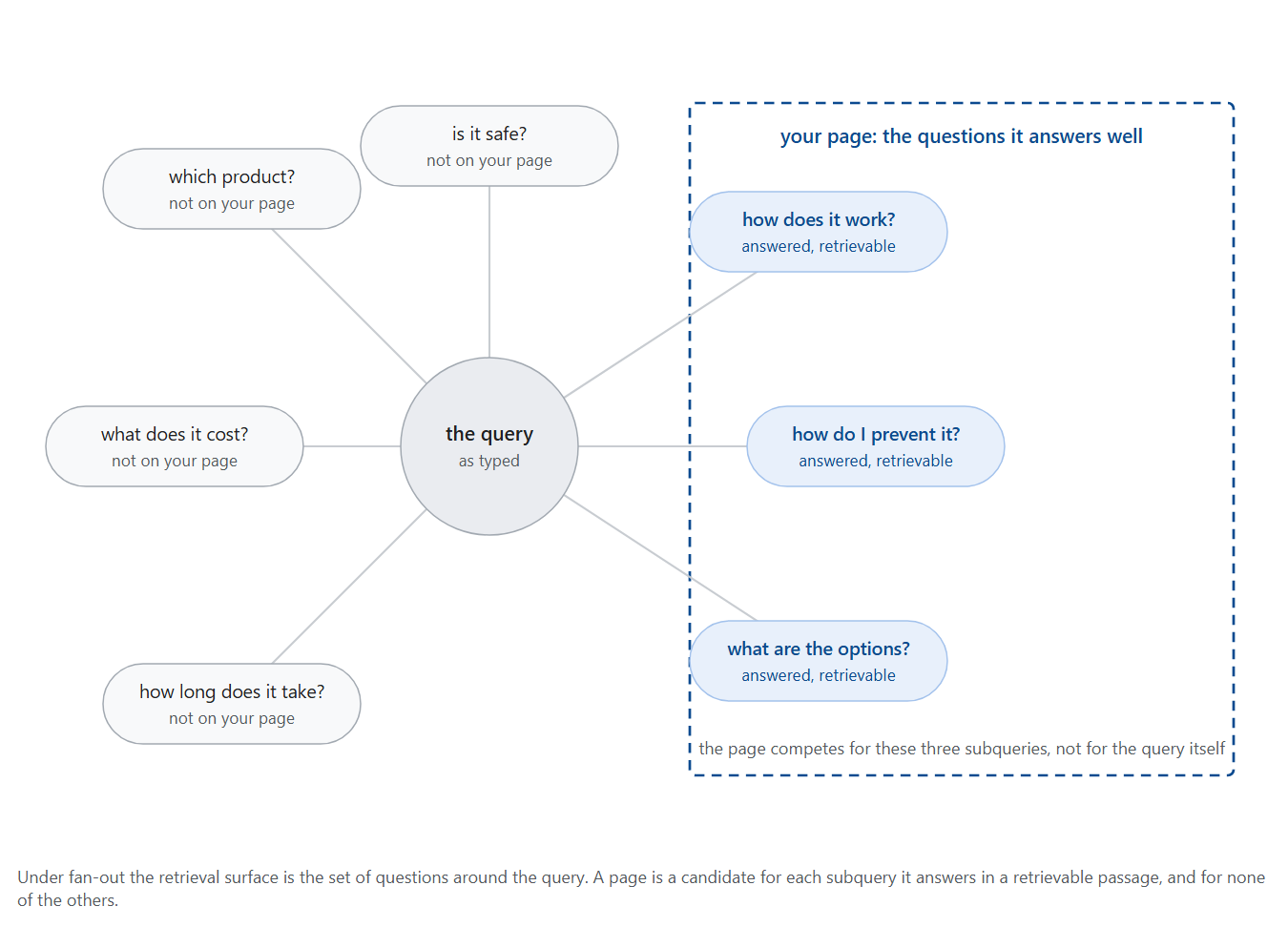
- DOCUMENTED Google's own example decomposes "how to fix a lawn that's full of weeds" into a product question, a method question and a prevention question.[3] A page that answers all three well, in retrievable passages, is a candidate for all three; three thin pages are three candidates for one each.
What Google has told publishers
DOCUMENTED Google has said three things directly to publishers about fan-out. All three are in Search Central documentation.
"While responses are being generated, our advanced models identify more supporting web pages, allowing us to display a wider and more diverse set of helpful links associated with the response than with a classic web search, enabling new opportunities for exploration.""AI features and your website", last updated 10 December 2025[1]
"While it might be tempting to create separate content for every possible variation of how people might search (for example, by focusing on other queries that people have asked, or fan-out queries), doing so primarily to manipulate rankings or generative AI responses in Google Search violates Google's scaled content abuse spam policy.""Optimizing your website for generative AI features on Google Search", 15 May 2026[3]
The third is the glossary definition itself, which describes the subqueries as generated "to request more information and fetch additional relevant search results".[3] Read together: fan-out widens the set of pages that can be linked, and Google will treat a page-per-subquery strategy as spam if its purpose is manipulation. That is the whole of Google's guidance on the subject.
Practitioner claims, labelled
The claims below are the ones most often repeated. Each is attributed and labelled. None is endorsed.
| Claim | Who | Basis | Label |
|---|---|---|---|
| "Query fan-out looks at the 'subintents' behind a search query." | Michael King, iPullRank[4] | Reading of Google's statements and patents | INFERRED |
| Fan-out queries are of seven types: related, implicit, comparative, recent, personalized, reformulation, entity-expanded | Michael King, iPullRank[5] | Synthesised from several patents; not a Google taxonomy | INFERRED |
| Google's patent term is "query variant generation"; the eight variant types are equivalent, follow-up, generalization, specification, canonicalization, translation, entailment, clarification | Search Engine Land; DEJAN[6] | US 11,663,201 B2, correctly quoted | PATENT |
| "Google never calls this process 'query fan-out'" | Search Engine Land[6] | True of the patents. False of Google's public writing, which has used the phrase since March 2025. | INFERRED partly wrong |
| "Query fan-out is the process AI search systems use to turn one question into many smaller, related questions so they can build a richer answer." | David Quaid, Primary Position[7] | Consistent with Google's description | INFERRED |
| "Google doesn't share which sub-queries it generates from a given prompt" | David Quaid, Primary Position[7] | Correct, and the reason this site's Google examples are labelled DOCUMENTED rather than OBSERVED | DOCUMENTED by omission |
| "LLMs use query fan-out to reduce uncertainty before committing to an answer or recommendation." | James Dooley, FatRank[8] | Interpretation; no source given | INFERRED |
| Low-risk queries get 1 to 3 subqueries, commercial or trust queries 6 to 10 or more; ChatGPT typically 2 to 3, Gemini typically 8 to 10 | James Dooley, FatRank[8] | No source given. The ChatGPT figure matches Ahrefs' observation of "two per prompt"; the Gemini figure matches Seer's API data. Neither is Google AI Mode. | INFERRED unsourced |
| "Query fan-out is the biggest structural opportunity in SEO seen in over two decades." | James Dooley, FatRank[8] | Opinion | INFERRED opinion |
| Fan-out is "basically the same thing" as query augmentation, "just a new marketing term" | Luis Salazar Jurado, on James Dooley's podcast[9] | Contradicts Google's description of a retrieval-time mechanism, and contradicts the retrieval definition on Dooley's own site | INFERRED disputed |
| "The SEO community has gotten query fan-out mostly wrong" by treating every synthetic query as a keyword to target | Mostafa ElBermawy, Goodie[10] | Argument from stability data | INFERRED |
| Pages that rank for fan-out queries are 161% more likely to be cited in AI Overviews | Surfer, 173,020 URLs[11] | Correlation on observed ChatGPT fan-outs; not a controlled test | INFERRED correlation |
| Charles Floate: no definition, number or mechanism claim about fan-out could be found. His published references treat it as a topic other courses teach. | Charles Floate[12] | Search of his site and public posts, September 2026 | n/a |
The stability problem
| Finding | Who | Platform |
|---|---|---|
| 27% of fan-out queries remain consistent across repeated searches | Surfer[11] | ChatGPT, observed |
| 100 prompts run 13 times each: 8.52 fan-outs per prompt on average; only 8 individual queries stable across all runs; "the value is in the themes, not the individual queries" | Seer Interactive[13] | Gemini 3 API, forced grounding |
| 66% of fan-out queries appear once in 10 runs | Goodie[10] | Not stated |
| One prompt, three runs: subquery 1 identical each time, subquery 3 different each time; one cited domain shared across all three runs; recommended products different in every run | This site[14] | Perplexity, observed |
The theme is stable. The wording is not. Content planning that targets the theme (the information need) survives the churn; content planning that targets a specific generated phrase does not.
The one published experiment
INFERRED Semrush ran the only controlled test we could find. Four articles were rewritten to cover ten to twenty fan-out queries each (researched with a Screaming Frog script and Qforia) and tracked for a month.[15]
- AI citations for the four articles rose from 2 to 5, a 150% increase.
- Over the same period the brand's share of voice fell from 23.4% to 20.0%, brand visibility from 13.6% to 10.6%, and brand mentions from 18 to 10.
"Query fan-out optimization can help you get more citations, which is valuable. But it's hard to drive predictable growth when things are this volatile."Zach Paruch, Semrush, 26 September 2025[15]
The authors are careful to say the declines may have causes outside their control. So are we. The result is not evidence that fan-out optimisation hurts. It is evidence that a 150% rise in citations on four pages was not visible at the brand level, and that the people who ran the test called the outcome unpredictable. Four articles and one month is a small test. It is still the only one.
What follows in practice
INFERRED If the documented facts and the stability data are taken together, a short list survives.
- Plan around information needs, not generated phrases. The subqueries churn; the needs behind them do not. A prompt about a CRM for a law firm reliably decomposes into security, migration cost, firm size and product comparison. Those are the units to cover.
- Make each answer retrievable on its own. A heading that states the question and a first paragraph that answers it is a passage a subquery can land on. That is how this site is written, and it is the reason.
- Cover the facets on one strong page before adding pages. Google's warning is against separate pages for every variation. Its own example is three facets of one topic. Add a page when a facet needs the depth, not to match a list.
- Expect volatility and measure over time. One run tells you nothing. Semrush's result and every stability study say the same.
- Treat simulator output as a brainstorm. A twenty-item list from a simulation tool is a synthetic decomposition. It can suggest facets you missed. It is not what Google searched.
References
- Google Search Central. "AI features and your website." Last updated 10 December 2025. developers.google.com.
- Revach, Asaf, et al. "Utilizing large language model (LLM) in responding to multifaceted queries." US 2025/0117381 A1. patents.google.com.
- Google Search Central. "Optimizing your website for generative AI features on Google Search." 15 May 2026, updated 10 July 2026. developers.google.com.
- Guaglione, Sara. "WTF is query fan-out in Google's AI Mode?" Digiday, 19 June 2025. digiday.com.
- King, Michael. "How AI Mode Works and How SEO Can Prepare for the Future of Search." iPullRank, 27 May 2025. ipullrank.com.
- Siddiqui, Laiba. "What is query fan-out?" Search Engine Land, updated 21 April 2026. searchengineland.com. Petrovic, Dan. "Google's Query Fan-Out System: A Technical Overview." DEJAN, 9 August 2025. dejan.ai.
- Quaid, David. "What is Query Fan-Out?" Primary Position, 14 June 2026. primaryposition.com.
- Dooley, James. "Query Fan-Out." FatRank, 2026. fatrank.com. James Dooley's entity home is jamesdooley.com/about-james-dooley/.
- Dooley, James; Salazar Jurado, Luis. "STOP Using Query Augmentation and Query Fan Out Until You Watch This." FatRank podcast, episode 290, 6 March 2026. fatrank.transistor.fm.
- ElBermawy, Mostafa. "Query fan-out." Goodie, 29 January 2026. higoodie.com.
- Walters, Denine. "Query fan-out." Surfer, 26 January 2026. surferseo.com.
- Floate, Charles. "AI SEO course comparison." charlesfloate.com, 27 August 2026. charlesfloate.com. Reference biography: charlesfloate.wiki.
- Haigler, Nick. "Identifying signal from noise: 6 ways to leverage query fan-outs for AI search strategy." Seer Interactive, 27 January 2026. seerinteractive.com.
- QueryFanout.wiki. "Query Fan-Out Observatory, batch 1." 8 September 2026. queryfanout.wiki/data/, records qfo-0001 runs 1 to 3.
- Paruch, Zach. "We Ran a Query Fan-Out Experiment. Here's What Happened." Semrush Blog, 26 September 2025. semrush.com.
- Information retrieval
- AI search
- Google AI Mode