Measuring query fan-out
What can actually be observed about query fan-out from outside the companies that run it, what can only be inferred, and what cannot be measured at all. This page is the reason the dataset has an evidence-class column, and it is where every tool that claims to show you a fan-out is sorted into "observes" or "simulates".
Three kinds of signal
| Signal | What it tells you | What it does not | Evidence class |
|---|---|---|---|
| The platform displays its searches | The wording and count of subqueries the platform chose to show | Whether the display is complete; what happened before display | OBSERVED |
| Grounding metadata from an API | The queries a model issued when grounding a response through the API | What the consumer product does; the API and the product are different systems | OBSERVED for the API only |
| Citations and response structure | Which information needs the response covered and which domains supplied them | How many searches ran, how they were worded, what was discarded | RECONSTRUCTED |
| A language model asked to guess | Facets you may not have thought of | Anything about any real system | SYNTHETIC |
Google AI Mode: what is observable
chrome:// address) that browser automation cannot read or screenshot. A headless browser hitting the AI Mode URL from the same network was stopped by Google's "unusual traffic" check before any result loaded. Every published number for AI Mode's fan-out is therefore either Google's own words or an inference from a different system.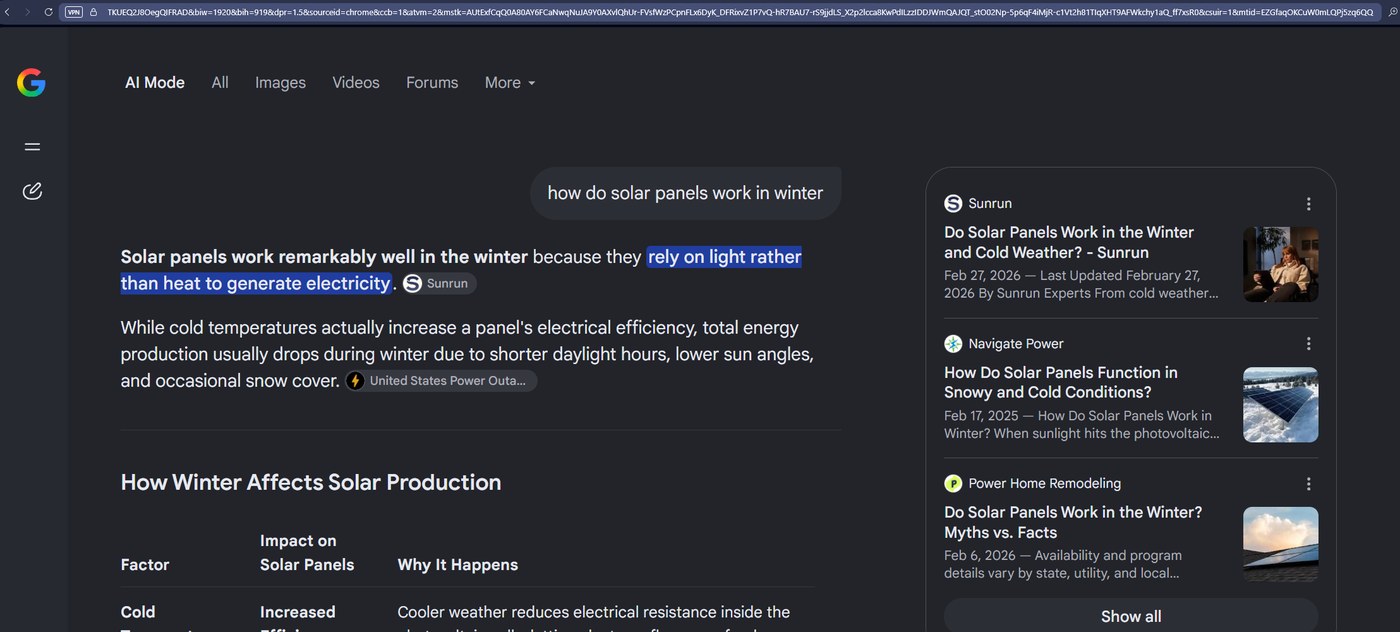
What AI Mode does expose:
- DOCUMENTED A set of links "associated with the response", which Google describes as wider and more diverse than a classic result page.[1] These are the raw material for a reconstruction.
- INFERRED Dan Petrovic reports, from prompt-extraction experiments in May 2025, that AI Mode exposes a Google Search tool with a specific call format, and concludes that AI Mode "is basically Gemini".[2] The tool list is an observation; the conclusion is inference; neither reveals the subqueries.
- DOCUMENTED Deep Search, the extended mode, produces a cited report; Google says it "can issue hundreds of searches".[3] The report cites sources but does not list searches.
Manual capture, by a person using Chrome and taking screenshots, remains possible and is how future AI Mode rows in the dataset will be recorded. Those rows will still be RECONSTRUCTED unless Google starts displaying its subqueries.
Other platforms: what is observable
| Platform | What it shows | How | Tested here |
|---|---|---|---|
| Perplexity | Each step's label, the searches run under it (wording and count), and the pages read, including direct page fetches as a distinct step type | Expand the "Finished N steps" panel above the answer, then expand each step | Yes, 11 prompts plus 2 repeats.[4] Follow-up turns showed no panel. |
| ChatGPT search | The searches it ran, listed under a "Searched the web" disclosure | Expand the disclosure; a bookmarklet and two browser extensions extract the list automatically[5] | Not yet |
| ChatGPT Deep Research | Activity log of searches and reads | Sidebar during and after the run. Ahrefs reports one product prompt triggering 420 searches[6] | Not yet |
| Google AI Overviews | Links only | n/a | Not observable |
| Google AI Mode | Links only | n/a | Not observable; see above |
TESTED On Perplexity, what is displayed changed between turns of the same thread: the first turn showed a step panel with three searches, the follow-up turn showed no panel but still attached new sources.[4] Display is at the platform's discretion. A missing panel means the platform did not show it, not that nothing ran.
API grounding metadata
OBSERVED for the API. When a model is called through a developer API with search grounding enabled, the response can include the queries the model issued. Two groups have used this at scale.
- Seer Interactive: 501 prompts through the Gemini 3 API with forced grounding, average 10.7 queries per prompt, range 3 to 28; 95% of the queries had no measurable search volume.[7] A second study ran 100 prompts 13 times each: average 8.52, with only 8 individual queries stable across all runs.[8]
- DEJAN: 365,920 grounding queries logged across Google/Gemini (158,186), OpenAI (207,174) and Amazon Nova (560) APIs; average length 56 characters; 71% of seven words or more.[9]
Tools: observe or simulate
Every tool below was sorted by one question: does it show queries a system actually issued, or queries a model guessed a system might issue? Names and claims are as the tools present themselves.[10]
Observe
| Tool | Source of queries | Platform covered |
|---|---|---|
| DEJAN Query Fan-Out (dejan.ai/tools/fanout) | API grounding metadata | Grounded Gemini and OpenAI models, not AI Mode |
| Ahrefs Brand Radar fan-outs | Queries returned with the response; Ahrefs notes "Most of the time we see two per prompt, even if there could be more" | ChatGPT, Perplexity |
| ChatGPT Search Query Extractor (shtros.com bookmarklet) | ChatGPT's own disclosure | ChatGPT |
| Keywords Everywhere extension | ChatGPT's own disclosure | ChatGPT |
| Keyword Surfer extension (used in Surfer's study) | ChatGPT's own disclosure | ChatGPT |
| Perplexity's own steps panel | The platform's display | Perplexity |
Simulate
| Tool | Method | Output size claimed |
|---|---|---|
| Qforia (iPullRank, open source) | Gemini, via the user's API key, asked what Google would fan out to; two modes, "AI Overview (simple)" and "AI Mode (complex)" | 20 to 30 typical; iPullRank describes it as a simulation |
| queryfanout.io (New Chemistry) | Not named; "built on Google's published methodology" | "8 to 12 sub-queries" |
| Otterly.AI fan-out | "By simulating the fan-out process" | Not stated |
| LLMrefs generator | Own model fine-tuned on prompt and fan-out pairs from its tracking | "10 to 20 or more" |
| Position Digital extractor | Selectable model; page calls it a simulator | Not stated |
| WordLift simulator and visual explorer | Gemini in Colab notebooks | Not stated |
| Wellows, PingAura, QueryBurst, SEO Review Tools generators | Not named | "8 to 12", "40+ variants" |
| Semrush Enterprise Query Fan-Out Analysis | Not disclosed | Not stated |
The split matters more than the tool names. Nothing in either list observes Google AI Mode. Every "AI Mode" simulator is a language model guessing. Guesses can be useful for planning; they are labelled SYNTHETIC on this site no matter what the tool calls them.
What cannot be measured
- UNKNOWN Whether a platform's displayed searches are all the searches it ran. Ahrefs says of its own capture: "there could be more used by AI to generate its answer."[11]
- UNKNOWN Anything about candidate subqueries that were generated and then filtered out. The patents describe that stage; no interface shows it.
- UNKNOWN The ranking or weighting applied to results from different subqueries before synthesis.
- UNKNOWN Whether a fan-out occurred at all on a platform that displays nothing, such as AI Overviews.
- UNKNOWN The effect of location, login state and personalisation on the decomposition. The dataset records these fields so that differences can at least be noticed.
References
- Google Search Central. "AI features and your website." Last updated 10 December 2025. developers.google.com.
- Petrovic, Dan. "AI Mode Internals." DEJAN, 28 May 2025. dejan.ai.
- Reid, Elizabeth. "AI in Search: Going beyond information to intelligence." Google, 20 May 2025. blog.google.
- QueryFanout.wiki. "Query Fan-Out Observatory, batch 1." 8 September 2026. queryfanout.wiki/data/.
- Shtros. "ChatGPT Search Query Extractor." shtros.com.
- Gavoyannis, Despina. "Query Fan-Out: What It Is and How to Optimize for It." Ahrefs, 2 March 2026. ahrefs.com.
- Haigler, Nick. "Gemini 3 query fan-outs research." Seer Interactive, 21 November 2025. seerinteractive.com.
- Haigler, Nick. "Identifying signal from noise." Seer Interactive, 27 January 2026. seerinteractive.com.
- Petrovic, Dan. "Fanout Query Analysis." DEJAN, 20 March 2026. dejan.ai.
- Anconitano, Veruska. "Query fan-out tools and software." Search Engine Land, 22 April 2026. searchengineland.com. Tool pages fetched individually; see Sources.
- Ahrefs Help Center. "How to view fanout queries generated by AI." help.ahrefs.com.
- Information retrieval
- AI search
- Google AI Mode